An Open Letter to Jimmy Fallon

Please go home. Don’t go away, just go home.

The thing I have always loved about you is how genuine you are—genuinely moved, genuinely playful, genuinely interested—so when you turned on your iPhone camera and were 100% yourself in quarantine it wasn’t just entertainment. It was the voice of displaced America. We all had our kids crawling all over us while we tried to pull off some semblance of work. We all were laughing and crying at the same time. We all had a time when it hit too close to home and we had to take a moment.

I cried with you when your friend died not because I knew him or even really knew you but because you let me in and I let you in and for a few minutes we weren’t trying to fix or understand the world. We were just sitting in it. 

You probably already know what a pressure release valve your show is in a time when almost all the things we do for self-care are unsafe, but it isn’t the same thing in studio. Whoever redesigned your set and put you in cardigans instead of suits is on the right track but it isn’t enough. We aren’t anywhere close to normal yet. I’m still navigating conference calls while my kid is negotiating screen time requests just off camera (they know how to leverage the situation). Your socially distant studio band just makes me feel like I missed the last train out of all of this.

It’s a little odd to have your guests at home and you in the studio, to see their kids running around but miss Winnie’s lost tooth. I’m not as interested in heavily produced bits. I’d rather see you do a TikTok attempt in your…where was that again? You seem to have an unending supply of unique spaces to film in, which was part of the charm of the Home Edition. I don’t have an indoor tree house but I kind of did when I let the Fallons into my quarantine bubble.And, honestly, you may get more laughs from the band and the crew but I preferred the occasional hard-won laugh from your wife and the obvious chemistry when you were trying to make her laugh. I know there are lots of reasons that returning to the studio is better for your work life and your home life but the Tonight Show used to be a bright spot in the pandemic and now it’s just another thing we’ve lost.

Try Something New: A Brief Waltz in a Little Room

I’m the sort of person who really enjoys stand-up comedy but hasn’t ever been to a live show. Beyond the dearth of time and money, it’s much more comfortable to watch from the safe distance of a screen where if I get tired or bored or offended I can easily toggle away. To do that in a live show I’d have to physically walk out which, whether I left in a huff or not, would be rude and draw too many eyes (and maybe even some humorous heckling from the comic).

So it goes with all shows. The screen, of course, offers the greatest anonymity and free escape for the audience, but traditional theatre-going also offers the audience a lot of padding. You are in a large group that is physically separated from the story telling space and your interaction consists of watching, laughing (or not), crying (or not), clapping (or not), and discussing it over dessert afterwards.

Theatre that asks more of us than we are used to giving, that strips us of our herd and places us in a position of being seen rather than just being the one who sees is a little scary. I can see why some people avoid non-traditional theatre. A show I recently attended may convince you that you shouldn’t.

The play, A Brief Waltz in a Little Room, is a series of short pieces on a theme that the audience of 10 people experiences individually as they move in different orders between 10 rooms the size of a dressing room (their function in a previous incarnation). Some contain an actor playing a scene but many are installations that flesh out the story or further place us in the role of the main character, Walter.

We went into each room twice and the play’s creators did something so lovely with that–we got to experience several locations entirely on our own as a bit of a break from the intensity of the play before discovering them again in the context of the story. This practice served as a rest/release for the audience and also added such a profound layer to the subsequent scenes as, more than we ordinarily would, we brought our own experiences and memories (distant and very recent) into the scene. It made those scenes so beautiful and emotionally engaging.

Throughout the piece there is a lot of attention paid to the audience’s experience and how that informs the storytelling. The actors are very careful to ask you before engaging with you physically (like putting a costume piece on you) and let you establish your own space and how close you will be so even the one scene that is very in-your-face is oddly comfortable. Well, comfortable isn’t really the word for it, but I trusted the actor. And I don’t generally trust strange men standing between me and the exit. This is the main reason I think you should give the play a try even if you don’t generally go for this sort of thing. They have taken pains to make this a safe space for the audience and because we feel safe we can experience the storytelling in a totally unique and engaging way.

This is the point in the review where you need to stop if you haven’t seen the play yet and come back when the next few paragraphs are no longer total SPOILERS.

Where to get your tickets: Sackerson.org


Ok, so now that the room is populated only with People In the Know, I’ll tell you about the two experiences in the show that impacted me the most. Part of the impact was not knowing they were coming so that’s why I sent the other folks away (seriously! Go see the show and come back. It’ll mean more to you.)

The first was when I was in the chapel with Walter’s daughter. I was immediately impressed with the idea that not only was I having an up-close view of her, she was having an up-close view of me. I sat next to her and thought about how I was simultaneously Walter and myself in those few minutes so I tried to give her the attention and love I would give my own child if she was saying those things to me. By the end I felt I had to say something. The music was playing and I was supposed to leave. But as a mother and as a child with her own unfinished business I couldn’t just walk away. I thought about what I would say if this was my child and what I would want my father to say if I had been in this daughter’s position. I stood up and as I was walking out I turned back to the actor and whispered “I’m sorry.” Because of the place I was coming from it was loaded with meaning for me, but I was shocked when the actor’s head snapped up and tears were forming in her eyes. I have no idea what her side of the equation was but for me it was an electric moment of connection. That was the moment the play became something I was feeling more than I was watching. I became even more of a participant rather than an intimate observer and it resonated fully.

The other room that had a stronger impact on me was the bathroom. I loved the concept but was wary of the camera on the first time through and when I landed in the bedroom before my second trip to the bathroom I was seized with a bit of horror at seeing footage from the bathroom projected above me. And I hadn’t even written my worst secret on the wall! Actually, I didn’t even fully write the secret I wrote because I decided it would be misinterpreted so I didn’t finish the sentence and added another clause that made it nearly unrecognizable. Still, though, I truly felt that mortification of being caught in my secret for a moment or two.

Then I laid there and enjoyed the pontifications of my fellow audience member. My favorite part was when she said, “And that’s all I have to say” and then turned back a second later with “Actually, it’s not…” I greatly regret not going up to her after the show and giving her a hug. She was delightful! Seeing that, though, made me acutely aware when I entered the bathroom a second time that I was being watched. I could only choke out two sentences before turning away from the camera and I was glad not to know who was on the receiving end. The encounter had really brought home the feeling of secret keeping and being exposed.

I could go through each room like this–the quiet intimacy of the car, the sweetness of the clementines under the stars, the stark isolation of the phone messages, the uncomfortable fracturing of the mirrors (a beautifully jarring backdrop for the moment of love and acceptance), etc. The play was truly a sampler of storytelling and each pass brought us closer to the core–not the core of the play, but the core of ourselves.



Summer Shows: Hindsight and How I Learned to Drive

First off, let me apologize for reviewing two shows just as they are closing. You haven’t entirely missed out, but read this quickly so that you can go buy your tickets right away. Or, better yet, go buy your tickets and come back to read this.

It’s been a rough month and I haven’t been to my open mic at all, much less scads and scads of theatre, but the Fear of Missing Out is strong with me and so, in between shifts in the hospital with my dad I went to a couple of shows that I am sincerely glad I did not miss out on. The first was Hindsight (written by Morag Shepherd, directed by Alex Ungerman, and produced by a company called Sackerson in Salt Lake City). I’m a little stingy with my SLC theatre going because it’s just so dang far away but the concept for this one was unique enough that I knew I may never run across another show quite like it.

The audience was limited to six people and we all met at a bus stop in downtown Salt Lake City so we could wander around with three actors as they wandered backwards through a romance. We had headphones on so we could clearly hear what they were saying and so we could hear the soundtrack. The way it was explained was that we were the camera in a film and we got to choose what shots we included in the movie we saw (how close we were, what angle etc). I absolutely loved that concept! Even when we weren’t directly engaged with the actors it all felt like scenes in my movie. And, actually, directly engaged is too strong of a term. We were watching them from a safe distance. We were people watching. Except it was so much more enjoyable than people watching generally is because we got to hear all that they were saying, stalk them legally, and see the whole darn story. You don’t get that kind of closure on your average bus ride. Trust me. I am that person who looks like she is quietly reading a book but is actually listening to your conversation. I will admit that openly to the few people who read my blog. People are just so darn fascinating.

Beyond the concept, though, the writing did such a great job of subtly moving you through the story. I don’t want to give anything away (since you’ve gone and bought your tickets already) but at one point a seemingly tiny detail from one scene is further explained a few scenes later in such a way that everything you thought you knew about the scene you just saw is shattered. I usually see stuff like that coming (hazards of being a playwright) so I was pretty much gobsmacked to be so blindsided. I loved it!

This play was supposed to end in June but was extended through July due to how popular it had become and now they have added two more weeks in August. They will sell out quickly and you will pretty much hate yourself if you miss out on this one.

The second play I saw was How I Learned to Drive (written by Paula Vogel, directed by Liz Golden, and produced by An Other Theater Company in Provo). This play closes Saturday night so that’s why I’m up late on Friday writing a blog post. You have less than 24 hours to see this one. Hop to it. This is the first show I’ve seen at this theater. It is a new player in town, located in a store front at the Provo Towne Centre Mall (which seems to be transforming itself into a bit of an arts hub) and we are nearing the end of its first season. I wish I had walked through those doors a whole lot sooner. They did a fantastic job and I walked out of there so happy that a company like this exists in Utah County (if only to save me some driving).

I bought my tickets after reading a truly horrifying review of the play (one that has since been taken down due to how offensive it was). I’ve been off the grid for artistic endeavors since my dad became ill and I hadn’t even realized this play was being produced but when I read that review I knew I had to go support the theater that had taken on this particular show in a fairly conservative community. The cast was entirely women, which made it a little easier to sit through. The women playing men, especially the woman playing Uncle Peck (Chelsea Hickman), were very effective in their adoption of male physicality and unapologetic in the fact that they were women taking on the role of the male. Somehow that very clear message of “I am a woman. I’m going to now be the man in this story for a short time but I’m still a woman” kept the stage a safe place, despite the things we were seeing and hearing.

I also really liked casting an older actor (Cathy Ostler) as the main character because we had that juxtaposition of experience and inexperience, hindsight and lack of understanding, throughout the entire piece (even more so than we may have gotten if the role had been cast with a 30-something or 40-something woman as is often done). At the end of the play nobody stood up to walk out. I honestly thought there was going to be some sort of talkback session that I had missed the announcement of. When it became clear that people just weren’t standing up to leave because they didn’t want to stand up to leave I realized that I didn’t want to either. It felt like it would be breaking some sort of sacred space that had been created. I’d be there still if I hadn’t brought along my not-timid-friend (thank you, Allisan).

So there you go: my slap dash review of two shows that justify my crazy compulsion to See All The Things. Next time I’ll try to let you know a little earlier in the run.


Summer Fun with Dear Data

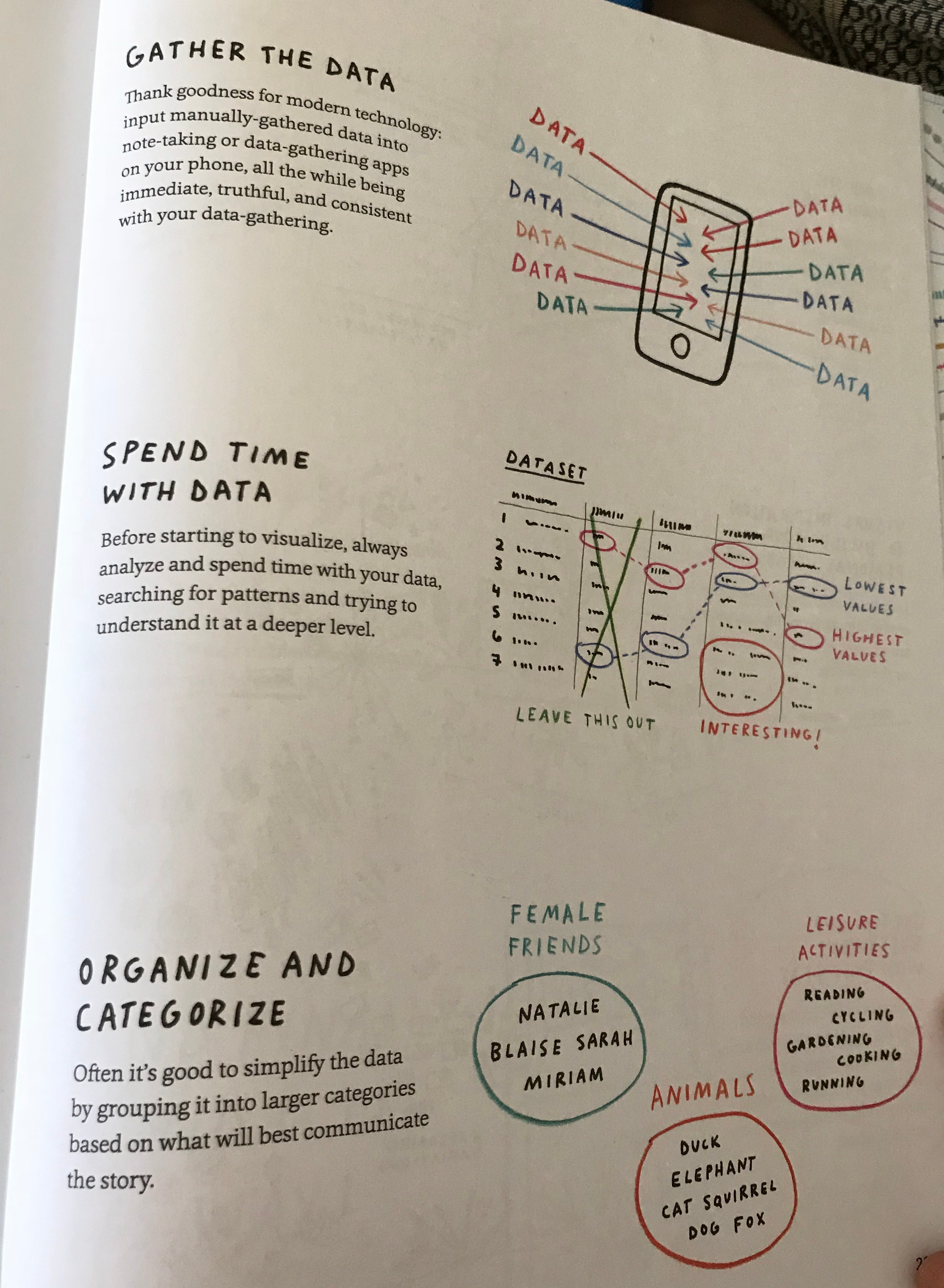
My nephew’s wife (my bonus niece) showed me a fabulous book the other day called Dear Data (by Giorgia Lupi and Stefanie Posavec). It tells the story of two graphic artists and data crunchers who came up with a very innovative year-long project. Each week they would choose a different bit of personal data to track and at the end of the week they would represent the data graphically on a postcard and send it to each other. It was fascinating!

IMG_8053

As a person with both left brain and right brain tendencies, I knew this was something I had to try too. This summer my daughters and I are doing various art projects that we don’t have time for during the school year (like a neighborhood chalk festival!) and we decided it would be fun to track data with friends and family. We decided on four questions we wanted to ask and we decided that the resulting data graphics would go up in our gallery at the end of the summer. (A year or so ago we started putting art and poetry up on our fence and calling it the Plein Air Word Gallery.)

If you would like to participate, here are the rules:

* You may do any question whenever you would like but you must track the data for seven consecutive days and you must only track ONE question at a time (#3 is an exception to this rule because it is more of a snapshot of one moment in time)

* Your graphic representation must fit on an 8.5”x11” size paper (unless you do your own laminating and bring it to me)

* No profanity or otherwise offensive material will make it on the fence (this is a family neighborhood with lots of little kids in our audience).

* Only photos or photocopies can hang on the fence (no original art) because it gets moldy and ruined by the weather.

* Bring me a copy of your original graphic (laminated or in a sheet protector) to

o My house (if you know me that well)

o Speak For Yourself Open Mic on Thursday Nights at 7:30 pm (if you’re in the Provo area)

o Speakforyourselfopenmic AT gmail DOT com (if you don’t have a way to get it to me in person)

The Questions:

1. Pieces of trash picked up

2. People who smile back when you smile at them

3. Clothes you own and where are right NOW (no cheating)

4. Small acts of service done by you or observed in others (FYI, this one counts for LDS Young Women’s Personal Progress! Good Works #1)

Here’s information from the book that the authors included if anyone wanted to try their data experiment (like we do!):

img_8054.jpgimg_8055.jpg

img_8056.jpg

IMG_8057

For examples and even MORE information about the project, check out their website: Dear Data, the project

See Tully Despite Your R-rating Ban

If you don’t watch R-rated movies you may not have given the movie Tully a second look but you should. It’s not that it isn’t R-rated content but it’s more don’t-watch-this-with-children R-rated than damage-your-soul R-rated. Tully is a movie that takes an unflinching look at one of the more intense periods of motherhood (immediately pre- and postpartum) and anybody who has had a baby can tell you that that has a lot of bits that aren’t suitable for viewing by children.

I read the spoiler of a review in the New York Times (Diablo Cody, Responding to Criticism, Says ‘Tully’ Is Meant to Be ‘Uncomfortable’) so I had a little bit of an idea of what I what I was going to see when I walked into the movie theater but it was still a pretty wild ride (and not quite what you might expect based on the movie’s trailer). There were exactly two of us in the theater when I watched it one Wednesday morning and about 3/4 of the way through my fellow movie go-er got up and walked out. Even though she was a stranger to me I wanted to run after her and tell her to come back. I didn’t, because I’m not creepy and I didn’t want to miss movie minutes harassing a stranger. So let me harass you instead.

There is a moment or two in the movie where everyone who has ever attended Sunday School will wonder what in the heck they got themselves into. You may want to walk out. If you can’t bring yourself to trust the filmmakers then trust me. It’s all going to be ok. It’s all necessary to get to the point of this incredible journey. Some of it could probably have gotten the point across in a less, ahem, explicit manner but some of it absolutely could not and even the former would have lost something valuable if it had been sanitized. We hear a lot about the pretty parts of motherhood and the acceptable chaos. But there are stories that are not heard because they make us uncomfortable. There are realities that are not part of the public discourse. There are women who are as unseen as the end of this movie because as a society we walk out. We don’t want to know. Best not to think about how sausages and humans are made.

A large part of this movie examines perceptions–from small things like both brothers-in-law thinking the other hates him to big things like The Big Reveal That Shall Not Be Named. The oldest child in the family is a special needs kid and spends much of the movie being seen as the Problem to be Addressed (not even as a problem to be solved, just as a problem). When we encounter someone who doesn’t see him that way we (and the mom) almost don’t know how to proceed. Part of what makes that scene so poignant is that for a large chunk of this movie no one challenged the school administrator’s perception of the child. No one looked beyond her basic assumptions about this kid, what his behavior meant, and what responsibility the adults in the room had towards him. The mom (Marlo) is overwhelmed by it, but she doesn’t challenge it.

It’s the same with the dad’s perception of Marlo–both how she is doing and what her responsibilities are. He lives very much in a world where dads “babysit” instead of parent and the two instances where that is challenged stand out in high relief because everyone seems to have his same perception. He is not painted as a bad person (though he is certainly called out on his perceptions twice more than he would be in real life), but the movie clearly shows the problems such perceptions cause. He may not be bad but he is most assuredly wrong and how his perceptions play out make the ending worth sticking around for. I described it to a friend as “the dad gets some redemption at the end” but, really, the whole family does. The black place you want to walk out of 3/4 of the way through the movie is the dark place they must crawl out of. It’s what needs to be truly seen.

I once heard someone argue that breastfeeding is preferable to bottle feeding because you don’t have to wake up the dad for help, which is good because men need so much more sleep than women do. My head nearly exploded at that one. Just because you get up out of bed and do what has to be done does not mean that you need less sleep. It just means that you are as tough as nails! The mom in this movie is all kinds of tough but what we see at the end of the movie is that not only is that unsustainable, it’s not the best way to live.

That is the take-away from this movie and I wanted to shout it from the rooftops. I wanted to round up every man I know and make him watch this movie. I wanted to tell them not to flinch, not to look away, not to walk out of the theater because they had a long day and their wife totally has this under control. Your wife is as tough as nails She is very capable. That is not in dispute. But making and raising humans is not a one person job. She needs just as much sleep as you do, no matter what society might expect of her and of you. And movie watching is more nuanced than just checking the rating. Challenge your perceptions.