
See Tully Despite Your R-rating Ban

If you don’t watch R-rated movies you may not have given the movie Tully a second look but you should. It’s not that it isn’t R-rated content but it’s more don’t-watch-this-with-children R-rated than damage-your-soul R-rated. Tully is a movie that takes an unflinching look at one of the more intense periods of motherhood (immediately pre- and postpartum) and anybody who has had a baby can tell you that that has a lot of bits that aren’t suitable for viewing by children.

I read the spoiler of a review in the New York Times (Diablo Cody, Responding to Criticism, Says ‘Tully’ Is Meant to Be ‘Uncomfortable’) so I had a little bit of an idea of what I what I was going to see when I walked into the movie theater but it was still a pretty wild ride (and not quite what you might expect based on the movie’s trailer). There were exactly two of us in the theater when I watched it one Wednesday morning and about 3/4 of the way through my fellow movie go-er got up and walked out. Even though she was a stranger to me I wanted to run after her and tell her to come back. I didn’t, because I’m not creepy and I didn’t want to miss movie minutes harassing a stranger. So let me harass you instead.

There is a moment or two in the movie where everyone who has ever attended Sunday School will wonder what in the heck they got themselves into. You may want to walk out. If you can’t bring yourself to trust the filmmakers then trust me. It’s all going to be ok. It’s all necessary to get to the point of this incredible journey. Some of it could probably have gotten the point across in a less, ahem, explicit manner but some of it absolutely could not and even the former would have lost something valuable if it had been sanitized. We hear a lot about the pretty parts of motherhood and the acceptable chaos. But there are stories that are not heard because they make us uncomfortable. There are realities that are not part of the public discourse. There are women who are as unseen as the end of this movie because as a society we walk out. We don’t want to know. Best not to think about how sausages and humans are made.

A large part of this movie examines perceptions–from small things like both brothers-in-law thinking the other hates him to big things like The Big Reveal That Shall Not Be Named. The oldest child in the family is a special needs kid and spends much of the movie being seen as the Problem to be Addressed (not even as a problem to be solved, just as a problem). When we encounter someone who doesn’t see him that way we (and the mom) almost don’t know how to proceed. Part of what makes that scene so poignant is that for a large chunk of this movie no one challenged the school administrator’s perception of the child. No one looked beyond her basic assumptions about this kid, what his behavior meant, and what responsibility the adults in the room had towards him. The mom (Marlo) is overwhelmed by it, but she doesn’t challenge it.

It’s the same with the dad’s perception of Marlo–both how she is doing and what her responsibilities are. He lives very much in a world where dads “babysit” instead of parent and the two instances where that is challenged stand out in high relief because everyone seems to have his same perception. He is not painted as a bad person (though he is certainly called out on his perceptions twice more than he would be in real life), but the movie clearly shows the problems such perceptions cause. He may not be bad but he is most assuredly wrong and how his perceptions play out make the ending worth sticking around for. I described it to a friend as “the dad gets some redemption at the end” but, really, the whole family does. The black place you want to walk out of 3/4 of the way through the movie is the dark place they must crawl out of. It’s what needs to be truly seen.

I once heard someone argue that breastfeeding is preferable to bottle feeding because you don’t have to wake up the dad for help, which is good because men need so much more sleep than women do. My head nearly exploded at that one. Just because you get up out of bed and do what has to be done does not mean that you need less sleep. It just means that you are as tough as nails! The mom in this movie is all kinds of tough but what we see at the end of the movie is that not only is that unsustainable, it’s not the best way to live.

That is the take-away from this movie and I wanted to shout it from the rooftops. I wanted to round up every man I know and make him watch this movie. I wanted to tell them not to flinch, not to look away, not to walk out of the theater because they had a long day and their wife totally has this under control. Your wife is as tough as nails She is very capable. That is not in dispute. But making and raising humans is not a one person job. She needs just as much sleep as you do, no matter what society might expect of her and of you. And movie watching is more nuanced than just checking the rating. Challenge your perceptions.
What Diana doesn’t know: Feminist commentary in “Wonder Woman”

The biggest source of comic relief in the movie “Wonder Woman” is the juxtaposition of Diana’s ultra-competence in battle with her utter lack of competence in all things “womanly” (ok, not all things). Having been raised outside of the male gaze, she hasn’t learned to defer to males in terms of governance, she hasn’t learned that her body is an object to be lusted after, and she doesn’t care whether the guy in the bar ever answers the question of whether to be afraid or aroused at the sight of her. Yes, she does follow Steve Trevor around like his little lost puppy, but the reason she is lost is because life with males as distant figures is so very different from life as we know it (making her “Born Yesterday” appearance itself a form of feminist commentary).

From the start of the movie, men and women are cast as two different species. There are Men, who are mortal and fallible, and there are Women, who are Amazons. Sure, there are mortals who are female, but we are (for the most part) encouraged to forget them as one scene wonders — the woman whose plea inspires the much previewed press into No Man’s Land, for example. Even pervasive characters like the plucky secretary Etta Candy and Dr. Poison have one essential moment before fading into the shadows of a male-dominant world.

The Amazon Women, though, aren’t doing too much better by being tucked away on a hidden island spending all of their time training to defeat their own dominant male (thus creating a grown woman who knows how to swing a battle axe but can still say with a straight face that she was created by being formed out of clay and breathed to life by a god). She looks hopelessly naïve when she says that (guess Amazon Mama didn’t have the “birds and the bees” talk with little Diana), and there are similar comic setups for her simple view of war and her expectations for male behavior. Wonder Woman is presented mainly as someone who doesn’t know things we take for granted. The list of things Diana doesn’t know is pretty long: Diana doesn’t know ice cream, Diana doesn’t know corsets, Diana doesn’t know babies, Diana doesn’t know social boundaries — but especially, Diana doesn’t know her own origin story and her full power. It befuddles me that Amazon Mama felt that ignorance was Diana’s best defense and that she could really send Diana out into the world to meet her fate with her blinders still intact. I know Amazon Mama meant well, but it was infuriating to see her push Diana back into ignorance over and over again.

Being ignorant didn’t keep Diana safe — it just meant that she met her fate on someone else’s terms and not her own. It’s interesting that Diana couldn’t defeat her enemy until she became The Diana Who Knows. The movie is also bookended with this version of Diana — the one who can slip easily through the world in her pencil skirt, who has found a way to navigate the world of Men, who holds secret stories in her heart that men only wish they knew. The movie is the journey from The Diana Who Doesn’t Know to The Diana Who Knows, and we are left wondering at the end if this is a good thing (though we presume it is). But even this more savvy secret Amazon can’t help but look back wistfully at The Diana Who Doesn’t Know. We don’t know what compromises The Diana Who Knows has had to make over the years (though one can make some assumptions based on the fact that her shield is on display in a museum case and her pencil skirt hasn’t been ripped in two by a good roundhouse kick), but we end the movie with the hope that even though Diana Knows Men, she’ll always have a piece of the Diana Who Doesn’t Know Boundaries. That is what resonated with me — feeling the shared weight of being Women Who Know how the dominant male world works and having the shared memory of a Woman Who Doesn’t Know the boundaries and expectations, doesn’t care about that, and kicks a lot of deserving tush as a consequence.

Does this journey make me feel empowered? Sort of. Probably a better description would be cautiously optimistic. I’ve only just met The Diana Who Knows. I don’t really know how she fits into this world. I only know she put her lot with the fate of Men, she has compromised on her dress, and she’s nostalgic about her adventure with the first man she ever met. I hope she continues to call Men out on the ridiculous things we seem to just accept as a society. I hope she keeps her ideals. But at the end of the movie, I really don’t know for sure what will happen for Wonder Woman, and as I read commentary that goes back and forth on whether or not this movie is truly feminist commentary and truly a breakthrough movie, I am similarly at sea about the “Wonder Woman” franchise. Is this a new era for blockbuster movies? Could be. Maybe. I’m cautiously optimistic. I want to see more. I want to know what happens next for the Movie Director Who Knows, the Writer Who Knows, the Actress Who Knows, and the Audience Who Knows. Where will we go from here?

**Published previously in the Southern Utah Independent on June 17, 2017: What Diana Doesn’t Know

I am Definitely Not Sexist (or Racist or Homophobic)

“Give me some credit,” he said to me, at least three times, after he told me several stories meant to establish his cred as Definitely Not Sexist. An older man, he has been quite open about his vote for the current President so he’s a little touchy about such things in the politically and socially liberal community of writers we are both a part of. “Don’t worry,” he seemed to say, “I’m not a product of my generation.”

I knew as soon as I read Nora Ephron’s 1996 Wellesley graduation speech at the open mic we both frequent that this conversation would be coming. It’s what happens when you engage otherwise thoughtful men about gender issues. International Women’s Day was that week as well so I actually had several conversations in that vein. The one that stuck out to me occurred when a 20-something woman wondered on social media about why there was an International Women’s Day. What about men? Aren’t they also great? Wasn’t this oppressive to them? (Quick answer to that last question: NO).

Several women answered, reflexively, that every day is men’s day (one supplied the actual date of International Men’s Day) and a 20-something man took exception to that. “Give me some credit,” he seemed to say. “I am Definitely Not Sexist.” And because he was Definitely Not Sexist, he didn’t seem to see how he shut down the conversation with the patronizing comment “I love you too much to argue with you” or how inflammatory it was to assert that not only were women as privileged as men, some women were more privileged than men.

Another woman pointed out that this 20-something guy was a good guy and meant well (and didn’t he have a point about how men and women should be treated equally?). The problem with this response, though, is that his status as a good guy who meant well was not being challenged (neither was our shared understanding of the value of equality). There is a feeling that if you are ever uninformed, misinformed, or insensitive that you are Definitely Sexist (irredeemably so). It’s that crazy logic that leads people to scramble to establish themselves as Definitely Not Sexist. People (and issues) are not so very tidy, though. I know this because I am Definitely Not Racist and Definitely Not Homophobic.

I’m not always aware of my privilege as a white, middle class, straight, cisgender woman and sometimes (ok, pretty much all the time) when someone points out some of these things I get defensive (even if I don’t always voice it). I am, generally speaking, a thoughtful person. I’m empathetic and fair. I work for equality. Anyone who knows me could affirm that. Except my ex-husband. Don’t ask him. So why do I get defensive? Because for most people in the universe I am one dimensional. I am “poetry lady” or that funny post or the church organist or the person who never ever ever volunteers to be Room Mom.

There are people out there who know me (and judge me) based on one experience or type of experience. That’s what our technological bonanza has done—our field has broadened but we don’t have the time/energy/brain power to know everyone we come into contact with as a multi-dimensional, nuanced human being. So a sexist action becomes a sexist person and the response invariably is “Hey wait! I am Definitely Not Sexist!” That response just shuts down the conversation, though.

We have to create spaces where we understand and love each other, where the basic understanding is that we are not sexist/racist/homophobic but that we do need to understand each other better and improve our behavior and language. This is a two-sided initiative. We need to stop jumping right to Definitely Not Sexist mode and thus miss out on valuable information. And we also need to stop talking about our issues and people who disagree with us in one dimensional ways. I will admit that “every day is men’s day” was probably not the most helpful retort if my goal was to have a multi-dimensional discussion that actually makes a difference in the struggle for equality. I will also admit that that was not my goal at the time. It’s incredible that, over 20 years later, Nora Ephron’s speech about not being complacent about women’s issues is still timely. Twenty years after I was a 20-something who needed to hear that message there are 20-somethings who mistake their privileged position as universal, who feel that because our struggle looks a little different from our mothers’ struggle that it isn’t a struggle at all.

I didn’t have to quit my job when I became pregnant but I did have a job offer rescinded once when a man applied (because he had a family to provide for, of course, and I was just a single woman). Sound like something out of 1959? That was 1999. And though it’s more likely they wouldn’t say it outright in 2017, don’t you doubt that this sort of thing goes on today (here in Utah for sure). The truth is, dear 20-somethings, that there is still no gender parity in pay, productions, and publications. And, even more basic than that, when men come up against a romantic encounter gone wrong they fear for their egos but women fear for their lives. Looking at a world filled with facts like that and still thinking that women’s issues are fixed because you are more enlightened than your father is like pretending it isn’t raining because you are standing under an umbrella.

But back to International Women’s Day, which has been around since 1911. How come it gets more ink than International Men’s Day, which was created in 1999 (presumably by people who are Definitely Not Sexist)? When you are culturally dominant you don’t need extra effort to bring attention to your issues. It’s redundant. Last year the Springville Library had a bingo card style reading program to encourage people to branch out and try books they might otherwise overlook. There were squares labeled “read a sci-fi novel” or “read a book by a local author” and then, because they’re Definitely Not Sexist, there was a square labeled “read a book by a man.” Since you can’t spit in any direction in a library without hitting a book by a man, this gets nobody out of their comfort zone. This diversifies nothing. Maybe put that one in the center square, ok? That’s why International Men’s Day isn’t so terribly different from every other day and why International Women’s Day doesn’t oppress men. If all things were equal then we wouldn’t need to be reminded of all the ways things aren’t equal. And I have tons of man-loving cred, folks, so you can believe me on this one. I am Definitely Not Sexist.


**This was originally published in the Southern Utah Independent on March 25, 2017: I am Definitely Not Sexist (or Racist or Homophobic)

Mansplaining the Temple at BYU’s Education Week

When my sister and I attended Brigham Young University’s Education Week this year, we weren’t expecting mansplaining and sexism to be part of the discussion. This is our third year, so we are still relative newbies. We didn’t realize that a class in 3220 WSC is a class with two overflow rooms (aka popular), so we ended up snaking through three different classrooms’ worth of line and landing in the large “audio only” overflow (overflow No. 2). The class, a thoughtful discussion of the temple, was still well worth the effort, so the next day we came two classes before the targeted class so we could be in the actual room with the speaker and slides. You have high expectations when you put in that much effort, but again, it was well worth it.

The speaker, Alonzo Gaskill, was a prime example of why you go to Education Week: He was thoughtful, faithful, incredibly well-read, and insightful. He was also wrong. Not capital W wrong. Not picket-the-Wilkinson-Center wrong. More of a “thanks for playing” kind of wrong.

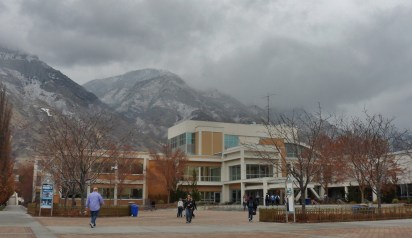
byu_ernest_l-_wilkinson_student_center_building
BYU’s Wilkinson Center

He opened with an article he had read that quoted Mormon women about their misgivings about LDS temple services. I can’t remember if they were quoted anonymously, but in any case it was an article, not a kitchen-table discussion, and he couldn’t really directly address these specific women. After expressing regret that this was the case, he laid out an interpretation of the historical and doctrinal underpinnings of modern temple worship that he felt addressed their concerns. I have to award very genuine kudos for that. Too often, concerns like this are dismissed with the assumption that such expression is evidence of a lack of faith or of impending (or current) religious inactivity. Engaging in thoughtful dialogue is exactly what we need for these and other issues.

I’m simplifying this tremendously, but the basic idea that Brother Gaskill conveyed is that temple worship falls in line with the common metaphor that the church is the bride of Christ (see Ephesians 5:25, Revelation 21:2, and Matthew 25 for starters). In the endowment, according to Gaskill, women represent the church and men represent Christ. Because of this, all references to the subservience of women are really metaphors for all humanity’s (women’s and men’s) subservience to God. He also noted that having women veil their faces is symbolic of humanity’s need to rely on God (as well as further visual for the bride of Christ metaphor). He went into much more detail in the hour-long class (and has several books on the subject: “The Truth About Eden: Understanding the Fall and our Temple Experience,” “Temple Reflections: Insights into the House of the Lord,” and “Sacred Symbols: Finding Meaning in Rites, Rituals, and Ordinances”). It was fascinating. But his oft-repeated refrain bugged me: “The archetype erases all of the sexism.”

I appreciated his perspective. I was glad that he didn’t attend the temple and think “you are less than me” when looking across the room at his veiled sisters. His research and thoughtful consideration enriched my own temple worship.  But erase all of the sexism? That it did not do.

First, it was a bit arrogant to presume that the way you’ve worked out an issue for yourself 100 percent addresses someone else’s concerns. In fact, it sounds a lot like mansplaining. I know he meant well, but please, Brother Gaskill, don’t mansplain the temple for me. Even just a little bit. Put forth your theories, sure. Continue the discussion. But don’t close the case without input from the people who raised the concerns in the first place. It reminds me of when I have a student turn in a paper with a note that their mentor/tutor has already told them that the paper was passing. Well, gosh, then I guess my opinion on the paper doesn’t really matter. I’m just the one in charge of actually evaluating it. The heart of mansplaining is setting yourself up as the expert on someone else’s thoughts and feelings. Any man, no matter how well researched, is not going to be the be-all-end-all expert on how a woman feels about the temple (which is not to say that a man isn’t welcome in the discussion).

It’s really a matter of how it is framed. Maybe instead of “The archetype erases all of the sexism,” you say “The archetype really helps me to overcome questions of sexism in temple imagery.” Second, even if you embrace the “bride of Christ” archetype, it doesn’t take a big leap to understand why people might find it sexist that men are always the ones in the god role in the endowment. Yes, Brother Gaskill pointed out that women take on that archetypal role in the initiatory ordinance, but while men take on the god role for men and women, women only take on that role for other women. That’s a bit of sexism the archetype doesn’t address.

Let me be clear: I am not in any way protesting the temple ceremonies. But I take exception to the idea that it would be illogical and inappropriate to raise issues of sexism in relation to temple worship. I was endowed nearly 22 years ago. I’ve been to the temple as a single person, a married person, and a divorced person. I was an ordinance worker, briefly, before my oldest child was born. I feel strong and empowered in the temple. As a temple worker, I thrilled in being authorized to perform ordinances with the power of God. As a temple patron, I draw strength from the peace found in the temple and from specific blessings received there. I feel like the universe opens up with my potential in these walls. But I also know that wording and presentation have impact. And I know that even with the best intentions, we can get things wrong.

provo_utah_temple_1
The Provo, Utah LDS Temple; Photo:Ricardo630/CC BY-SA 2.5

Recently, I pointed out to a friend what I perceived to be sexist phrasing on a restaurant menu (and, to answer the inevitable question, yes, the discussion will someday be part of a piece for The Independent). Her response was “I’m sure they didn’t mean it that way.” Ever hopeful for humanity, I’m sure they didn’t consciously demean women on their menu, either. At some point, though, intent loses relevance. The reason we point out problematic phrasing regardless of intent is because we’re trying to root out cultural practices that are not in line with intent. Talking about the temple is different than talking about menus, because menus don’t include an element of revelation, but I don’t think it’s out of line to point out that whatever the metaphor, the optics leave something to be desired. So let’s keep chatting about that. But let’s also make sure that all voices in this discussion feel heard and respected. No more mansplaining, please.

[This essay appeared originally in The Independent on October 8, 2016: Mansplaining the Temple at BYU’s Education Week: Examining Charges of Sexism ]

Update: I emailed Bro. Gaskill this essay and he responded with one sentence–“You obviously didn’t listen closely enough.” I rest my case.