
Will Drive For Food

I can’t remember when we started the Bakery Quest. It wasn’t conceived as a road trip; it was a lifestyle. The pure Bakery Quest is this: we want to visit all of the bakeries in the world. To that end, when we see a bakery we haven’t been to the appropriate action is to immediately pull over. We order all things that look good and divide them between all members of the party. Vocal judgements are made and the wisdom of returning or not returning is established.

We have found some incredible bakeries this way, most notably when driving on a small highway in rural Utah after a weekend of hiking. We happened upon it in one of the few months it is open (during the high season of Zion National Park) and we haven’t found it open on any of our subsequent visits. That’s why you strike while the iron is hot: who knows when you’ll cross paths with this bakery again?

So when I started reading William Least-Heat Moon’s Blue Highways and felt the tug of the road, I immediately thought of food. There is a joy in finding obscure food that you love or that other people love. It creates an instant connection. And after a year of being mostly homebound we are itching to get back on the road. Because of the pandemic I didn’t want to stay overnight anywhere that wasn’t in my bubble so I limited myself to day trips and uniquely Utah foods (of which there are many). When a crowdsourcing post on Facebook got 47 replies in 10 minutes I knew I had hit a vein. So what food do Utahns feel strongly about? Fry sauce.

Until I moved to Utah, fry sauce was my own private concoction. I assume that at some point my parents (both native Utahns) taught me how to make it, but it feels like I have just always known that ketchup is a runner-up for fry accompaniment. If you have access to mayo and mustard you can turn that ketchup into a plate-puddle of the good stuff. It wasn’t until my freshman year at BYU that I ever had commercially prepared fry sauce. It felt like people were trying to shrink wrap my grandmother’s applesauce cookies.

Because of that, I’ve been more of a passive Utah fry sauce consumer. I don’t seek it out specifically, or, rather, I didn’t until now. Now I want to try them all. It won’t be the same as a carefully proportioned salmon colored blob with white and yellow at the edges on a melmac plate, but few things are.

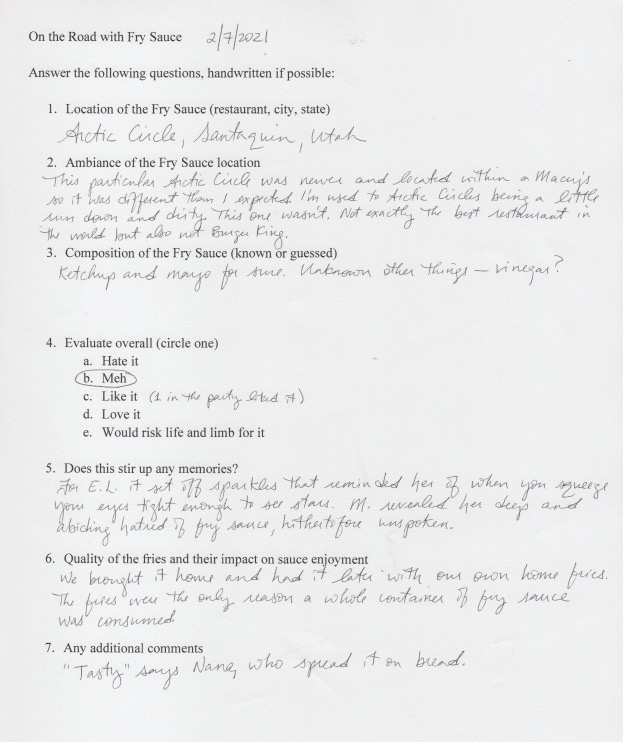
I want to try all of the fry sauce within a day’s drive of the Provo area and I will evaluate them here as I go along. I have made the fry sauce survey form available on the cloud for downloading/printing here. Please fill it out and send it to me (email at the bottom of the form) if you, too, want to be mindful about your condiments (because I probably can’t hit all of the places personally and because your perspective is also valid). I’m also up for trying your personal recipes so send those along too (no house calls unless I know you personally and Covid precautions are in place).

The first place we went to is Arctic Circle. I know. Talk about fast food commercialism. But Arctic Circle lays claim to the title of First Fry Sauce in the U.S. Well, technically, they call themselves “America’s First Fry Sauce” but what they mean is the United States. The ketchup/mayo combination purportedly originated in Argentina in the mid-1920’s at a golf club and is know as “salsa golf.” Don Carlos Edwards, the founder of Arctic Circle, started marketing it here in Utah in the 1940’s (with no knowledge of golf sauce). This is the earliest documented evidence of the sauce in Utah so I had to start there.

I was unimpressed. It was perfectly ok, but not something to bring a person to Arctic Circle above all else and really just one click above ordinary ketchup. We finished the cup just because it was there and we had fries. I sure hope Utah, Idaho, and select portions of Arizona have more to offer. Also, I learned upon hitting up our first fry sauce joint that my youngest kid hates fry sauce, a fact that had never previously been voiced. She prefers the Bakery Quest. Of course. Everyone does. That’s why the Bakery Quest a lifestyle and fry sauce is a fleeting obsession.

Any bets on how long before we can turn her into a fry sauce connoisseur? Tune in for more in the next installment of On the Road to Fry Sauce.
America, the Beautiful(ish)

America, the Beautiful(ish)

Recently I decided to write a few poems in the style of a dear poet friend, Dennis Marden Clark. This one has stuck in my head as a bit of a prayer during this “election season” so I wanted to put it out there as a potential source of comfort for battle-weary voters like me.

Dennis told me it works better when you sing it so here it is, an untrained voice with no accompaniment so you can imagine we are all sitting at Enliten Bakery and I’m standing at the mic sharing my latest crazy first draft of a poem. Take comfort in the fact that I am more reliably on key than Dennis.

America, the Beautiful(ish)

Oh beautiful, for cloudy skies

for amber waves of gain

for mountains mottled brown and black

for houses on the plains

America, America

God shed His grace on thee

and wake thy soul to mercy’s role

and see as He would see

Oh beautiful, my patriot’s dream

may last not one more year

malignant cities cease to gleam

though washed with human tears

America, America

your peace and grace I seek

uncrown the rude, find brotherhood

from sea to lake to me

Oh beautiful, for immigrants

whose strong, impassioned feet

a thoroughfare for freedom’s want

was never stopped or beat

America, America

must mend its every flaw

look in thy soul, find self-control

make liberty the law

Oh beautiful, for heroes proved

in liberating vote

who more than self their country loved

and mercy more than dough

America, America

may God thy heart refine

till all success be nobleness

and every gain divine

Why I’m Voting for Biden/Harris and Why I’m Putting This on My Fence

Some of you may know that I curate a small outdoor gallery of poetry and art on the fence outside of my home. We call it the Plain Air Word Gallery and we put up exhibits at random times on random topics. They generally stay up until the weather brings them down. Our newest exhibit is all about voting, with information about how to vote in our area, how to judge the veracity of sources, and how to discern media bias. I’m also posting the following personal essay for reasons that will become apparent as you read. This is by no means comprehensive and I have no desire to argue with trolls, but I feel compelled to do all that I can to make sure our democracy survives. This is my small contribution to the fight.

Earlier this summer my neighbors hung several huge pro-Trump flags at their house. It wasn’t surprising as I already knew where their vote had gone in 2016 and I already know that I live in a conservative part of a Republican state. But it brought politics into my neighborhood (and my day) in a way that wasn’t really comfortable. My sister wanted to send me a similarly sized Biden flag but that felt retaliatory and I didn’t want to have a neighborhood war. I also didn’t want to poke at my Republican neighbors the way I felt poked at with the Trump flags. 

When it comes down to it, a political flag or sign is a blunt instrument in a social landscape that is quite nuanced. I love and respect my neighbors. I do not doubt that all of the potential Trump voters on my little block are thoughtful, caring people who are trying to do what is best. I simply disagree with them greatly about exactly what is best in this election. So, because we are all thoughtful people who care about each other, I am taking a moment to tell you more than just who I’m voting for. I’d like to tell you why.

There are two categories of reasons to vote for Biden/Harris: reasons to vote for them and reasons to vote against the current administration. I’ll address both but I’ll start with the latter because, for me, it’s such a slam dunk. For four years I have watched this administration tear down this country. Unqualified people have been given power to ignorantly and/or maliciously dismantle important structures, thinking not of the American people but of wealthy supporters. Corruption wasn’t routed out. This administration opened the front door and welcomed it in. Want a pardon? It’s for sale. No ethical considerations needed. And no need to separate personal business interests from the business of running the country. If it benefits Trump it benefits America, right? Nope. Not even close. And now he won’t even concede if he loses the election. In fact, he is actively seeking to disenfranchise voters and circumvent standard election procedures. These are not the actions of a person who loves democracy. These are the actions of a person who loves power.

This is to say nothing of how personally odious the man himself is. I’ve had people say to me “I don’t understand why you have such an irrational hatred of him.” I do have a pretty strong negative reaction to the current occupant of the White House. I hate to even say his name. Some of you feel that is extreme. Let’s walk through that.

When he was an inconsequential entertainer and potentially shady businessman (if you thought about it, which none of us really did) he didn’t make me this angry. He was ridiculous and crude and someone I wouldn’t have wanted to share space with, much less work with, but he didn’t make my head explode. His rise in the Republican primary was unbelievable but I remember the 2016 caucus and how even hardcore Utah Republicans in my district seemed disgusted by him. As more and more things came out about him during the presidential race it seemed impossible that the American people would stand for it.

In November 2016 I was deeply wounded when the impossible became reality. It was not just that my candidate didn’t win a high stakes election. I have experienced that with feelings of disappointment but not feelings of betrayal. This man had so blatantly told the world who he was—a liar, an abuser, a crook, a crude and cruel man—and my fellow Americans, my neighbors, had said, “No problem.” I know there are complex reasons for why people felt they had to vote for him but on that day it felt like people I love were saying, “Yeah, I know he’s abusive and horrible, but I just don’t care.” Actually, some people said that outright. This is what makes my head explode. And watching him continue to blatantly show his lack of fundamental decency and morals on a broader scale to the cheers and adulation of a segment of population that includes people I care about makes my head explode even more. 

Four years of relentless assaults on decency and compassion have turned me from deeply wounded to deeply angry. Because I’m a woman that translates to “hysterical” or “irrational” when I am critiqued but let me assure you that it is entirely rational to feel betrayed by my fellow citizens in these circumstances. I felt comfortable in this community because I felt like we had a foundation of shared ideals even if we sometimes disagreed on how to achieve them. I feel betrayed because it seems like that foundation has been tossed aside.

When the President assaults peaceful protesters and you say, “He dominates the streets!” it feels like you don’t share my belief in the right to free speech and the responsibility a President has to keep people safe. When he admits to sexual abuse and you laugh it off as locker talk it feels like you don’t think I should be safe from assault. And when pundits and Senators mock sexual assault victims and you laugh with them you make me feel like you are not a safe person to hear my own vulnerable stories. This is why I feel betrayed. Not hysterical. Betrayed.

“But what about Biden?” I hear many of you say. It’s true that my anti-Trump argument has a wider base than the pro-Biden section of my argument does. I’ve had four years to work on the former and only a few months to work on the latter. Biden was not my candidate in the primaries (not because he is a bad candidate, but because there were others I liked better). But he’s a decent human being who loves this country and who has a solid track record of not demolishing democracy. And he chose Kamala Harris as his running mate, someone I’ve been impressed with since early primary race days. She’s smart and well-spoken with a palpable excitement about making positive change. 

When I watched the Democratic National Convention I thought, “Here are people who will help heal this deeply wounded country.” When I watched the Republican National Convention I thought, “Here are people focused on retribution and personal gain. Here are people who baldly lie to the public and none of their supporters seem to care.” Read both of their acceptance speeches and see the contrast for yourself (Biden: https://www.npr.org/2020/08/20/901380014/fact-check-bidens-address-to-the-dnc-annotatedTrump: https://www.npr.org/2020/08/27/901381398/fact-check-trumps-address-to-the-republican-convention-annotated )

Biden has stood up against violence against women and gun violence. Harris has taken on corrupt corporations seeking to exploit vulnerable populations. Listen to what they actually say and read what they have actually written (without the filter of a conservative opinion-maker). You might find what I found: that these are fundamentally decent people that can work with people all across the political spectrum, that will be leaders who serve all Americans, and that will trust the experience and expertise of the many people who have dedicated their lives to this country and this people. I’m tired of every day being another gut punch to everything I hold dear. It’s time to start healing as a nation or, as Biden puts it, to build back better.

Try Something New: A Brief Waltz in a Little Room

I’m the sort of person who really enjoys stand-up comedy but hasn’t ever been to a live show. Beyond the dearth of time and money, it’s much more comfortable to watch from the safe distance of a screen where if I get tired or bored or offended I can easily toggle away. To do that in a live show I’d have to physically walk out which, whether I left in a huff or not, would be rude and draw too many eyes (and maybe even some humorous heckling from the comic).

So it goes with all shows. The screen, of course, offers the greatest anonymity and free escape for the audience, but traditional theatre-going also offers the audience a lot of padding. You are in a large group that is physically separated from the story telling space and your interaction consists of watching, laughing (or not), crying (or not), clapping (or not), and discussing it over dessert afterwards.

Theatre that asks more of us than we are used to giving, that strips us of our herd and places us in a position of being seen rather than just being the one who sees is a little scary. I can see why some people avoid non-traditional theatre. A show I recently attended may convince you that you shouldn’t.

The play, A Brief Waltz in a Little Room, is a series of short pieces on a theme that the audience of 10 people experiences individually as they move in different orders between 10 rooms the size of a dressing room (their function in a previous incarnation). Some contain an actor playing a scene but many are installations that flesh out the story or further place us in the role of the main character, Walter.

We went into each room twice and the play’s creators did something so lovely with that–we got to experience several locations entirely on our own as a bit of a break from the intensity of the play before discovering them again in the context of the story. This practice served as a rest/release for the audience and also added such a profound layer to the subsequent scenes as, more than we ordinarily would, we brought our own experiences and memories (distant and very recent) into the scene. It made those scenes so beautiful and emotionally engaging.

Throughout the piece there is a lot of attention paid to the audience’s experience and how that informs the storytelling. The actors are very careful to ask you before engaging with you physically (like putting a costume piece on you) and let you establish your own space and how close you will be so even the one scene that is very in-your-face is oddly comfortable. Well, comfortable isn’t really the word for it, but I trusted the actor. And I don’t generally trust strange men standing between me and the exit. This is the main reason I think you should give the play a try even if you don’t generally go for this sort of thing. They have taken pains to make this a safe space for the audience and because we feel safe we can experience the storytelling in a totally unique and engaging way.

This is the point in the review where you need to stop if you haven’t seen the play yet and come back when the next few paragraphs are no longer total SPOILERS.

Where to get your tickets: Sackerson.org


Ok, so now that the room is populated only with People In the Know, I’ll tell you about the two experiences in the show that impacted me the most. Part of the impact was not knowing they were coming so that’s why I sent the other folks away (seriously! Go see the show and come back. It’ll mean more to you.)

The first was when I was in the chapel with Walter’s daughter. I was immediately impressed with the idea that not only was I having an up-close view of her, she was having an up-close view of me. I sat next to her and thought about how I was simultaneously Walter and myself in those few minutes so I tried to give her the attention and love I would give my own child if she was saying those things to me. By the end I felt I had to say something. The music was playing and I was supposed to leave. But as a mother and as a child with her own unfinished business I couldn’t just walk away. I thought about what I would say if this was my child and what I would want my father to say if I had been in this daughter’s position. I stood up and as I was walking out I turned back to the actor and whispered “I’m sorry.” Because of the place I was coming from it was loaded with meaning for me, but I was shocked when the actor’s head snapped up and tears were forming in her eyes. I have no idea what her side of the equation was but for me it was an electric moment of connection. That was the moment the play became something I was feeling more than I was watching. I became even more of a participant rather than an intimate observer and it resonated fully.

The other room that had a stronger impact on me was the bathroom. I loved the concept but was wary of the camera on the first time through and when I landed in the bedroom before my second trip to the bathroom I was seized with a bit of horror at seeing footage from the bathroom projected above me. And I hadn’t even written my worst secret on the wall! Actually, I didn’t even fully write the secret I wrote because I decided it would be misinterpreted so I didn’t finish the sentence and added another clause that made it nearly unrecognizable. Still, though, I truly felt that mortification of being caught in my secret for a moment or two.

Then I laid there and enjoyed the pontifications of my fellow audience member. My favorite part was when she said, “And that’s all I have to say” and then turned back a second later with “Actually, it’s not…” I greatly regret not going up to her after the show and giving her a hug. She was delightful! Seeing that, though, made me acutely aware when I entered the bathroom a second time that I was being watched. I could only choke out two sentences before turning away from the camera and I was glad not to know who was on the receiving end. The encounter had really brought home the feeling of secret keeping and being exposed.

I could go through each room like this–the quiet intimacy of the car, the sweetness of the clementines under the stars, the stark isolation of the phone messages, the uncomfortable fracturing of the mirrors (a beautifully jarring backdrop for the moment of love and acceptance), etc. The play was truly a sampler of storytelling and each pass brought us closer to the core–not the core of the play, but the core of ourselves.


Being Marianne in 600 Highwaymen’s Fever

I’d call this a spoiler alert but, technically, you can’t spoil this show. You can only alter the experience. That said, if you have tickets to see this show in the near future I’d probably read this afterwards.


Earlier this month I had tickets to see a show that had been brought in as part of BYU’s Off the Map theatre festival. Because the shows brought in are consistently fantastic I bought tickets months ago without really looking too closely at what the show was and forgot all about it. All I knew going into the show was that it was highly interactive. I didn’t know (nobody did) that afterwards the company member sitting next to me would tell me that in over 100 shows, this had never happened. The company member (Jax) had speculated on what might occur if it did but it had not, as yet, happened. Jax thought it would be magical and (spoiler alert?) it was.

Because I knew the audience would be a big part of the show I wasn’t surprised when my fellow audience members were called upon to be characters in the story or interact with the company members. Several were identified as this character or that character when Abby (the company member telling the story at that point) asked me to stand up and take a few steps into the playing space, which was a large rectangle made by the seated audience members. At this point, though, we were more than just audience members. We were not the discrete lumps of two or three that we were in the lobby as we waited to go in. We had taken our first tentative steps towards being a unit and the full attention and energy of 70 people were focused on that corner. It was palpable.

Abby turned to the group, gestured to me, and said, “This is Marianne.”

I had never met this woman. We were not wearing name tags. We had not engaged in small talk in the lobby. The character’s name was Marianne, as it always had been, and she had unwittingly chosen a Marianne from the audience to be her. You might not think this is earth shattering. There were certainly audience members and company members who reacted to it like it was just a funny little oddity and when I tried to tell the story to people who hadn’t even been in the room it fell flat too. That’s why I am writing about it–to somehow give voice to the experience I had. Because it wasn’t just an oddity. It was a cosmic pay-attention-smack.

Abby went on to describe the woman and the things that stood out to me were that she was a mother, she was alone after a party, and she was in some distress. The kicker, though, was when she had me place my hands over my eyes and explained that Marianne was having an emotional reaction, that people wanted to comfort her but no one did so she was alone. Writing that out right now those words don’t particularly land. They probably don’t for you either. But in that particular moment of heightened reality and in that other-imposed physicality that was, coincidentally, so like my own, I started to cry.

There are so many reasons why that might resonate with an audience member and there was only one person in that room who knew any part of why the image of a mother feeling isolated in her distress would land so forcefully for me but because the character’s name was my name it felt like a public acknowledgment of private grief and because we were already one unit it wasn’t embarrassing or awkward. It was healing. Sometimes it is enough to say “I see you. I hear you.”

The night before the performance I had attended a large gathering of women from my church. We made blankets for a local children’s hospital, had dinner, and listened to a speaker. I had gone to it thinking, in part, that the speaker would be a balm to my soul. He was funny and had some good things to say but he didn’t really connect with me or with the friend who had come with me. “Has he ever had anything hard happen in his life?” she asked. I suspect the answer would be yes if we were to ask it of him, but we were all individual observers in that forum–unnamed, unseen, and separate. There were many good things that came out of that evening that made me feel more connected to my community but the speaker was not one of them and my private grief remained very private. The contrast between Thursday night and Friday night could not have been more stark. Granted, I am a theatre artist so it’s not so unusual that a theatre piece would speak more to my soul than a sermon at times but it was quite a contrast.

The show created such a visceral sense of unity and because I had become Marianne it all seemed pointed and pertinent–the give and take of being alternately an observer and a participant, the awkwardness of figuring out when to act, the validation of feeling a part of it all. It was bookended by this character, Marianne, and so it was all coloring her existence (and, by extension, mine) but most especially in relation to the situation that had so forcefully come to me at the top of the show. I thought about why, in life, I hesitated to act or reach out. I asked myself if I could go on without those who taught me. I wondered how to build this visceral sense of unity myself. Most of all, though, it gave me a space of heightened senses to alternately examine objectively and examine at some post-conscious level my most overwhelming and emotional problem currently. It was a relief to be wordlessly a part of the whole rather than the partnerless parent talking and talking in the spaces between herself and everyone else.

I have no idea what my experience would have been if the character had been named something else entirely or if I hadn’t been chosen to be her or if I hadn’t happened to be seated next to a company member who shared my awe of the situation. That’s the beauty of this type of show–so many moving parts, so many ways to make meaning. And, like life, the only way to spoil it is to fail to pay attention.