Blog

I am Definitely Not Sexist (or Racist or Homophobic)

“Give me some credit,” he said to me, at least three times, after he told me several stories meant to establish his cred as Definitely Not Sexist. An older man, he has been quite open about his vote for the current President so he’s a little touchy about such things in the politically and socially liberal community of writers we are both a part of. “Don’t worry,” he seemed to say, “I’m not a product of my generation.”

I knew as soon as I read Nora Ephron’s 1996 Wellesley graduation speech at the open mic we both frequent that this conversation would be coming. It’s what happens when you engage otherwise thoughtful men about gender issues. International Women’s Day was that week as well so I actually had several conversations in that vein. The one that stuck out to me occurred when a 20-something woman wondered on social media about why there was an International Women’s Day. What about men? Aren’t they also great? Wasn’t this oppressive to them? (Quick answer to that last question: NO).

Several women answered, reflexively, that every day is men’s day (one supplied the actual date of International Men’s Day) and a 20-something man took exception to that. “Give me some credit,” he seemed to say. “I am Definitely Not Sexist.” And because he was Definitely Not Sexist, he didn’t seem to see how he shut down the conversation with the patronizing comment “I love you too much to argue with you” or how inflammatory it was to assert that not only were women as privileged as men, some women were more privileged than men.

Another woman pointed out that this 20-something guy was a good guy and meant well (and didn’t he have a point about how men and women should be treated equally?). The problem with this response, though, is that his status as a good guy who meant well was not being challenged (neither was our shared understanding of the value of equality). There is a feeling that if you are ever uninformed, misinformed, or insensitive that you are Definitely Sexist (irredeemably so). It’s that crazy logic that leads people to scramble to establish themselves as Definitely Not Sexist. People (and issues) are not so very tidy, though. I know this because I am Definitely Not Racist and Definitely Not Homophobic.

I’m not always aware of my privilege as a white, middle class, straight, cisgender woman and sometimes (ok, pretty much all the time) when someone points out some of these things I get defensive (even if I don’t always voice it). I am, generally speaking, a thoughtful person. I’m empathetic and fair. I work for equality. Anyone who knows me could affirm that. Except my ex-husband. Don’t ask him. So why do I get defensive? Because for most people in the universe I am one dimensional. I am “poetry lady” or that funny post or the church organist or the person who never ever ever volunteers to be Room Mom.

There are people out there who know me (and judge me) based on one experience or type of experience. That’s what our technological bonanza has done—our field has broadened but we don’t have the time/energy/brain power to know everyone we come into contact with as a multi-dimensional, nuanced human being. So a sexist action becomes a sexist person and the response invariably is “Hey wait! I am Definitely Not Sexist!” That response just shuts down the conversation, though.

We have to create spaces where we understand and love each other, where the basic understanding is that we are not sexist/racist/homophobic but that we do need to understand each other better and improve our behavior and language. This is a two-sided initiative. We need to stop jumping right to Definitely Not Sexist mode and thus miss out on valuable information. And we also need to stop talking about our issues and people who disagree with us in one dimensional ways. I will admit that “every day is men’s day” was probably not the most helpful retort if my goal was to have a multi-dimensional discussion that actually makes a difference in the struggle for equality. I will also admit that that was not my goal at the time. It’s incredible that, over 20 years later, Nora Ephron’s speech about not being complacent about women’s issues is still timely. Twenty years after I was a 20-something who needed to hear that message there are 20-somethings who mistake their privileged position as universal, who feel that because our struggle looks a little different from our mothers’ struggle that it isn’t a struggle at all.

I didn’t have to quit my job when I became pregnant but I did have a job offer rescinded once when a man applied (because he had a family to provide for, of course, and I was just a single woman). Sound like something out of 1959? That was 1999. And though it’s more likely they wouldn’t say it outright in 2017, don’t you doubt that this sort of thing goes on today (here in Utah for sure). The truth is, dear 20-somethings, that there is still no gender parity in pay, productions, and publications. And, even more basic than that, when men come up against a romantic encounter gone wrong they fear for their egos but women fear for their lives. Looking at a world filled with facts like that and still thinking that women’s issues are fixed because you are more enlightened than your father is like pretending it isn’t raining because you are standing under an umbrella.

But back to International Women’s Day, which has been around since 1911. How come it gets more ink than International Men’s Day, which was created in 1999 (presumably by people who are Definitely Not Sexist)? When you are culturally dominant you don’t need extra effort to bring attention to your issues. It’s redundant. Last year the Springville Library had a bingo card style reading program to encourage people to branch out and try books they might otherwise overlook. There were squares labeled “read a sci-fi novel” or “read a book by a local author” and then, because they’re Definitely Not Sexist, there was a square labeled “read a book by a man.” Since you can’t spit in any direction in a library without hitting a book by a man, this gets nobody out of their comfort zone. This diversifies nothing. Maybe put that one in the center square, ok? That’s why International Men’s Day isn’t so terribly different from every other day and why International Women’s Day doesn’t oppress men. If all things were equal then we wouldn’t need to be reminded of all the ways things aren’t equal. And I have tons of man-loving cred, folks, so you can believe me on this one. I am Definitely Not Sexist.


**This was originally published in the Southern Utah Independent on March 25, 2017: I am Definitely Not Sexist (or Racist or Homophobic)
Meet the Muslims in Utah

Last summer a single dad friend of mine reported that his daughter, who is African American, asked him why they didn’t see very many other dads and other “brown kids” at the park. It’s a fair question (though I have to say that most folks wouldn’t object to hanging out with this white mom on a regular basis). Sometimes in this sugar cookie of a state we blonde-haired blue-eyed white people only ever see other blonde-haired blue-eyed white people in the course of our day so if you want to have diversity in your life you need to actively seek it out. It was in this spirit that I took my children to Meet the Muslims in Utah at the Utah Islamic Center in Sandy.

The Utah Islamic Center has opened their doors for visitors in a monthly open house for some time now but a surge in interest in the event caused them to open their doors to visitors every Friday in February and also some Sundays. That’s how I ended up finding out about the opportunity: a friend of mine responded to the Facebook event made by the Islamic Center. My sister and I took our kids (five between us) in the hope that knowing about the Muslims in Utah would give them greater understanding about their community and greater perspective on world events. What actually happened was even better than that.

We had a hard time finding the mosque because it was tucked into a corner of strip mall with nothing to call attention to it beyond an ordinary looking sign that could just as easily have read “CarpetsPlus.” They share an entrance and a grey, Berber carpeted hallway with a couple of other fairly ordinary looking office spaces and don’t even approach what you might imagine a mosque would look like until you are in the sanctuary itself. Unfortunately, because of this we ended up being late and missing the 7:30 prayer (still kicking myself over that!). When we arrived (and removed our shoes), we slipped into an open space on the carpet in the main area of worship with about 90 other people, including a fair amount of children.

I had thought that the entire event was more of an open house format so I began to get nervous when an hour passed and we were still listening to presentations from the Iman and other members of the mosque. I found them fascinating, but I’ve been to enough LDS stake conferences with my children to know what their limits are as far as listening to adults talk about serious things. It’s a pretty low threshold. I imagined that any minute they would start running circles around the sanctuary, much to the horror of our hosts and the mothers of all of the children currently sitting quietly upright on three sides of me. My children were starting to get a little lounge-y as it got later and later in the evening and I questioned the wisdom of what I was attempting. Perhaps the Muslims in Utah wouldn’t be so excited that I had brought along my wiggly LDS kids to disrupt their event!

We ended up staying at least another hour past the speakers, though, because we got caught up talking one-on-one with the members of the mosque. The children busied themselves with looking at the pictures on the wall, reading literature on Islam, interacting with the other children in attendance, and eating all the sweets they could get their hands on. I cautiously approached a woman wearing both a scarf on her head and a veil over her face. The woman who had talked about women’s issues and Islam during the presentation had encouraged us to approach women wearing hijab during the refreshments portion of the evening to talk with them about their personal reasons for choosing to do so and I knew that in regular life I may not have another opportunity. I especially knew that I would not feel comfortable approaching a woman wearing such an extreme form of hijab not due to fear but because nothing says “stay away” as much as covering everything but your eyes.

The woman, whose name she taught me how to pronounce but which I have no idea how to spell, was vivacious and bubbly—not at all what you would imagine from a woman conservative enough to cover her face almost entirely on a regular basis. She was passionate about her choice to wear hijab but said that the reasons were so personal and intimate that she didn’t want to be one of the presenters even though her husband encouraged her to do so. She said she did not grow up in a very strict, religious household but had a religious awakening in college and began to cover her hair in the hijab as a way to find more religious focus. When just covering her hair did not give her entirely the focus she wanted, she started covering her face too. She doesn’t wear it all the time (she understands some may find it intimidating) but she did note that when she was dating her husband he never saw her face until they were engaged. We had a great conversation about her experience wearing the hijab and the experience of non-Muslims encountering Muslims in Utah. First and foremost, my concern would be to not make such a woman feel uncomfortable. Since I was not familiar with the religious context of veiling the face, I would hesitate to approach simply because I wouldn’t want to offend. I assured her that as an LDS woman, I felt empathy with the struggles that Muslims in Utah might face. We certainly have our own history of the general population misunderstanding and demonizing our religion.

We also had a lovely chat with an older man named Sam, who explained more about the mosque (all 150 of the children meet in that same sanctuary in different corners for their religious instruction! Imagine holding all Sunday School classes in the gym of the church) and told us about his experience immigrating to the U.S.  I was in and out of this conversation as I was tracking my youngest in her circular path through the crowd, balancing books on her head. Yes, seriously. Books on her head. Eventually we parted, wishing we could stay longer. I asked my children what they thought of the evening and they were similarly engaged, citing things in even the more presentational (read: traditionally boring for kids) part of the evening. We talked all the way home in the car about what we had learned and what our impressions were.

As I thought about it, I realized that beyond gaining a greater understanding for Islam and for Muslims in Utah the event was also an opportunity to strengthen community ties and stand up with a potentially vulnerable group in our country. The members of the mosque were very genuinely happy we were there and we were very genuinely happy to be there. They wanted to be part of us and we wanted to be part of them. Rather than being separate groups with different cultural practices, we were all Utahns seeking to spread love and understanding. It made me feel really good to be able to do something proactive to show my support for Muslims in Utah and it was extremely gratifying to have those positive feelings reflected back. The evening was full of hope. While negative aspects of the national conversation about Muslims were acknowledged, the underlying assumption was that we were here because we all wanted to have a positive relationship. No one was guarded. No one was angry. It was just lovely. It was exactly as the world should be.

Originally published in the Southern Utah Independent on February 25, 2017: Meet the Muslims in Utah

Liberals Don’t Want the Plane to Crash Either: Unpacking the Political Meme

My dear conservative friends, please know that your liberal friends are not rooting for the country to fall into ruins or for the President to fail in a general sense. To use the analogy of the political meme that is floating around the internet, your liberal friends don’t want the plane to crash (even if the pilot is unpalatable).  Come on, folks, even if we disagree on priorities or policies, can we at least assume that as Americans we all want to see our country and citizens thrive? That both sides of any issue are populated with patriots?

Wishing for someone to be “successful” is a complex issue.  If the pilot’s stated goal was to steer the plane into the nearest mountain, should I as the passenger cheerily wish him well in that endeavor? In our common aims, I wish for the current administration to be totally successful. I hope that in the next four years (and beyond) we are all wildly healthy, wealthy, and happy. It may stick in my craw that the catalyst for said happiness is someone I dislike but I’m a practical person. I’ll take it. Anyone would.

What I can’t do is wish that the administration is successful with things like building a wall or contributing to a culture where women’s voices are marginalized. I can’t hope for the success of actions that I feel will work against our common goal of health/wealth/happiness. That is neither disrespectful nor divisive. Insisting that everyone who loves their country must wish for the unqualified success of the President is the grown-up equivalent of shoving a scrawny middle schooler to the ground, digging your knee into his shoulder, and shouting “Say you love it! Say you love to eat dirt!” (now there’s a political meme just waiting to be made).

In this country our leaders are not demi-gods. There is a certain amount of respect that is awarded whoever holds the office of President but unconditional devotion is not a requirement of citizenship. We can disagree and we can use what influence we have to forward actions we feel will benefit ourselves and our fellow citizens even if those actions are directly opposed to the President’s goals and objectives. We can hope that the President is unsuccessful without hoping that the country crashes and burns. We can withhold our respect until it is earned. We can read that darn crash-the-plane political meme fifty times, burst a blood vessel, and write a column about it. That’s what is so beautiful about this country.

Don’t forget that voices of dissent are inherently patriotic. Having a voice is what the founders of this country fought for. And, no, I am not advocating for you to lose your voice and not state your opinion (though I wouldn’t say no to not seeing that political meme for a while). Voicing a dissenting opinion does not take anything away from your right and ability to voice your opinion. It’s just another part of the discussion. So whether you are cheering the pilot of this plane or saying “Let’s roll,” know that we are all after the same thing in the end (which I know is one of the points of the crash-the-plane political meme but, goodness, that’s really not the best way to put it).

**Originally published in the Southern Utah Independent on January 28, 2017: Liberals Don’t Want the Plane to Crash Either

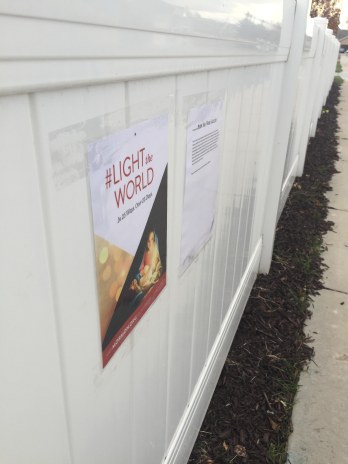
The Plein Air Word Gallery

light-the-world-call

Yep. That’s the gallery: a long vinyl fence in Utah County. It’s along a public walkway and near an elementary school bus stop. It will act as an ongoing gallery for poetry, creative writing, and visual art related to a theme which will change every couple of months. As this is an outdoor gallery and subject to the weather, please do not submit your only copy of the work. Protect your work with a sheet protector, lamination, or the like and bring to Speak For Yourself Open Mic on Thursdays at Enliten Bakery in Provo (7:30 pm to 9:30 pm). Submissions can also be emailed to pleinairwordgallery AT gmail DOT com but we have a limited capacity for printing so priority will be given to those submissions that are printed and protected against the weather.

December/January theme: #LightTheWorld

February/March theme:

“America is a nation of nations, made up of people from every land, of every race and practicing every faith. Our diversity is not a source of weakness; it is a source of strength, it is a source of our success.”

— U.S. Secretary of State Colin Powell

The Republican Voter and Being Ok (or Not): a Response to the 2016 Presidential Election

A food staple when I was growing up in Arizona was a Mexican-ish dish with lots of beans and spices. We called it Wetback Special. Because this term was never used in any other context in my family, I was at least 17 before I realized it was a derogatory term for illegal immigrants (who were generally from Mexico). In fact, many of the adults in the extended family didn’t realize this either. My family, like the families of most voters, did not teach me to hate people because they were different. We were schooled in equality, love, and inclusion. But we also ate Wetback Special. As I struggle to understand why people I love and respect voted for a candidate who embraces discriminatory language, practices, and political groups I keep coming back to that story. And as I hear everyone talking about being ok or not being ok (now or in the future) I wonder how many of my smart, thoughtful Republican voter friends are currently eating Wetback Special for dinner?

frito-pie

When I reached out to people I respect to talk with them about their vote (try it! It’s fun to talk respectfully with people you disagree with), I found that much of their reasoning focused more on the idea of a Republican administration and less on the candidate himself. In fact, one Republican voter said that the Access Hollywood tapes were nearly a deal breaker for her, until she thought about what she hoped to be the effects of a Republican administration. I approached it from an entirely opposite angle: more about the candidate and less about the Republican/Democrat divide. The reason for this was threefold: 1) the sky has not fallen in these years with Democrats in the White House (speaking, of course, from my own limited perspective) 2) party affiliation, in and of itself, does not qualify a person to govern 3) the Republican candidate did not/does not represent what I would call Republican values. It wasn’t a choice between Republican or Democrat for me. It was a choice between a person espousing inflammatory policies and empowering the worst impulses of our society and a person who, to put it succinctly, knows how to behave in polite society.

The interesting thing I found in my research was that every Republican voter I talked with agreed that the Republican candidate’s behavior was poor. Nobody defended him, personally. One Republican voter even went so far as to say “he is me from 10 years ago so I know he can change.” He felt that this was a person who could change for the better in office. The Democrat? Not so much. I noted that those were some pretty ambitious therapy goals for a guy with a very busy schedule and, from all appearances, zero desire to change, but this Republican voter remained convinced that the mantle of the presidency would be enough to expunge the excesses of the campaign. One voter dismissed troubling behavior by noting that it was just another example of the bad parts of our society that were already there and accepted (which seems about as good of reasoning as choosing to eat dirt because Pica exists).

I didn’t go around asking people who they voted for (my research was with self-identified Republican voters) but I suspect that the people running around on November 9th talking about being ok were this sort of voter. That’s how they could talk themselves into voting for someone so personally offensive. They felt it would be ok in the end. I can’t fault them for that entirely. Isn’t that how a lifelong Republican voter talks herself into voting for a Democrat? Where we differ is what things we felt were insurmountable.

And to make sense of that, I go back to the Wetback Special. The immediate universe I lived in as a child was a place where people didn’t call each other offensive names so I didn’t have personal knowledge of why that is harmful (though I certainly knew the concept in general terms). Is it possible that people could dismiss sexist and racist rhetoric not because their core beliefs are sexist and racist but because they do not viscerally understand the impact of what they know, generally, to be wrong? Are they so insulated from the effects of authoritarian men, sexual predators, and just plain crazy folks that it doesn’t seem like a big deal?

Even as I listened to my friends soften their candidate’s extreme positions and talk about the troubles they have seen with the Democratic administration, though, all I could think of was how these people that I love and trust listened to a man defend himself against rape allegations by saying the woman wasn’t pretty enough to rape and, by their actions in the voting booth, just shrugged their shoulders. That wasn’t media spin. That wasn’t 10 years ago. That wasn’t “out of context.” That was straight from his own lips. And the thought of people I trust being ok (in any way) with casual approval of sexual assault makes me feel unsafe. I don’t know how long it will be until that feeling subsides (or if it will). One Republican voter kept begging me to tell him what he could do to make me feel safe and (since he couldn’t—and probably wouldn’t—go back in time and change his vote) I had nothing for him. It’s like turning on the blender and then saying “How can I make this smoothie into a piece of fruit for you?” Maybe stop letting stuff like this go. Recognize that words have impact. And recognize the small and large ways that we do this stuff too (and then stop it).

fruit-smoothie

Some time ago, and with a bit of the necessary family drama, we stopped eating Wetback Special. We call it Mexican Haystacks now (due to its vague resemblance to another family favorite–a dish called Hawaiian Haystacks). And while it is still the same beans, spices, and corn chips, it tastes so much better. We can’t change the outcome of the 2016 presidential election. We can’t make the smoothie a piece of fruit again. But maybe we can stop eating Wetback Special.

[This opinion column was first published in The Southern Utah Independent on December 3, 2016: The Republican Voter and Being OK (or not)]