
A Tale of Two Fry Sauces (Well, Three)

I have a bit of a backlog of fry sauce experiences (which makes me concerned for my dietary choices) so I decided to focus on two for this post because they were diametrically opposed. Both were restaurants I had eaten at pre-pandemic and both are locally owned (not a chain).

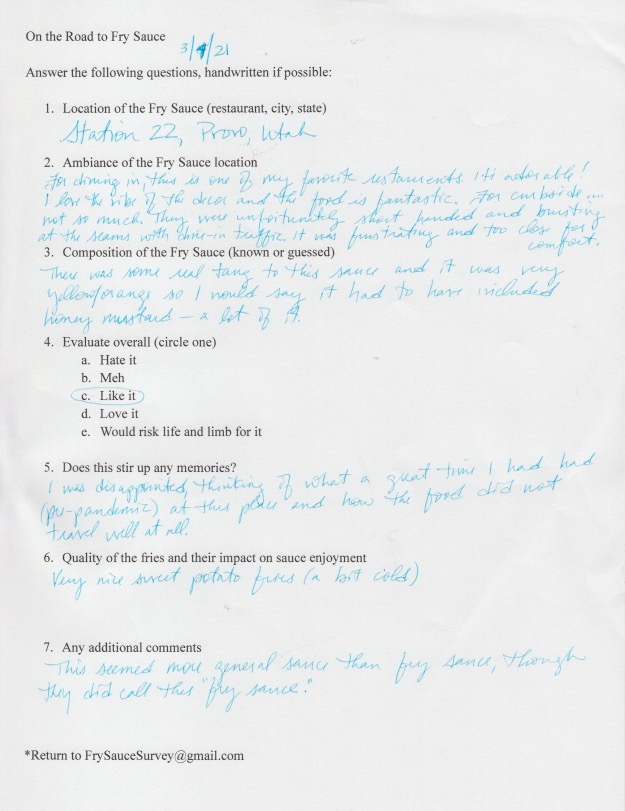
I had high hopes for Station 22 because I have had great experiences eating there. It has a fantastic energy and unique touches like a wall of specialty sodas. It has a wide array of sauces and was nominated for the fry sauce in particular, but it’s a long, narrow restaurant with little room for spacing out tables so we did the takeout option, which was not an option when I last ate at the restaurant.

Somehow on a Thursday night they were slammed. Understaffed, they didn’t even have time to attend to the folks who walked in, hoping to be seated (or pick up their takeout!). When one guy said he had been waiting for five minutes without anyone acknowledging him, I walked back to the server station to get an update. I felt bad pressuring them when they were so obviously distressed, but I had already paid for my food online an hour prior and we were starved.

We did eventually get sustenance (in about double the promised wait time) with unfortunate substitutions for the pie we ordered and missing biscuits, but the whole thing was a Curbside Cautionary Tale. Even the best dining experience, though, couldn’t have saved that fry sauce.

It was sauce. We put it on our fries. It wasn’t fry sauce. It was more of a honey mustard dressing mixed with a dab of ketchup. I had the fleeting thought that maybe they had made another unfortunate substitution, but I had double checked at the restaurant that this was what they were marketing as fry sauce.

It made me realize that the essence of fry sauce is the mayo. This is a mayo-based sauce and the best sauces highlight that, celebrate that. Station 22’s sauce ran away from its mayo roots and in doing so lost what make it distinctive.

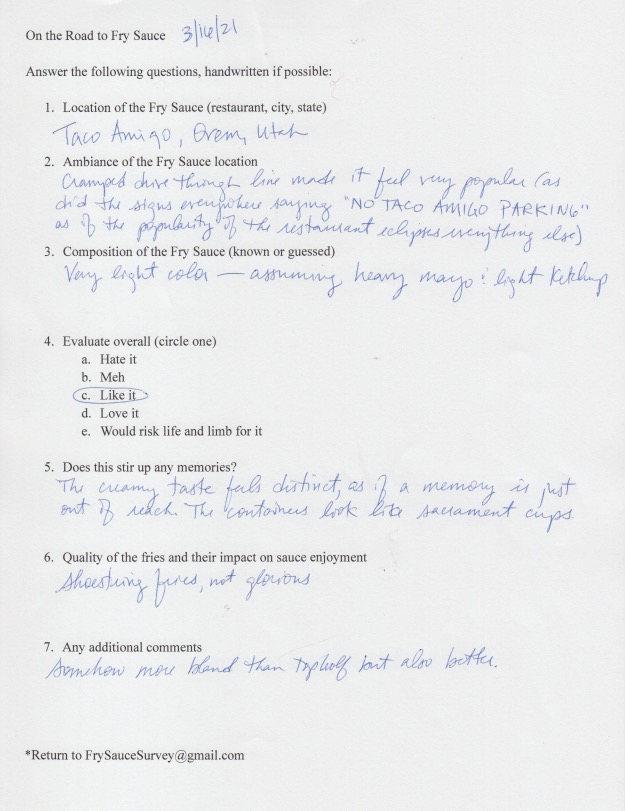
Compare this to Taco Amigo’s extremely light pink sauce. It’s somehow more bland than TopGolf’s fry sauce but it’s also 100% better. This is because it leans in to the mayo. It knows it’s a mayo sauce. I had always thought it was a matter of getting the tang just right (and that can be a factor in fry sauce efficacy) but embracing the bland can be just as powerful. Utah, home of the fry sauce, is much the same way. Don’t discount the bland. The bland is the whole point. Love your pasty white condiments. There is beauty all around–even in the mayonnaise and the white picket fences.

But Taco Amigo isn’t actually the second restaurant in this Tale of Two Fry Sauces (it was a side epiphany in the avalanche of deep friend potato experiences I’ve been having of late). The second restaurant was Seven Brothers in Riverwoods.

I had eaten there once a few years ago and hadn’t fallen in love. I had ordered a burger built for a much larger mouth than I had. I hadn’t ordered fries. I hadn’t gotten fry sauce. So when I had an hour to kill in North Provo at lunchtime I decided to try again. I had lunch in the very socially distant dining area (it was a pretty slow day) at this locally owned burger joint. This time I knew to not let my order exceed my jaw capacity and I had a lovely conversation with my server about their saucing.
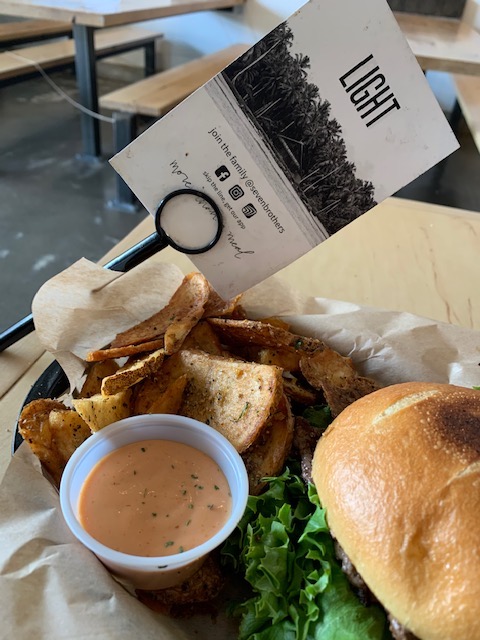
They make it fresh every day and go through 3 five-gallon buckets of it on weekdays (four or more on weekend days). It was just mustard, mayo, and ketchup with a chive garnish (unknown ratios). I was not a fan of their distinctive fries, which seemed like the love child of potato chips and potato wedges (forbidden love that is forbidden for a reason) but the sauce…hands down the best of the restaurant sauces. It was perfection. The whole plate was very pretty (the potato love child was nothing if not pretty) and the sauce had just the right amount of tang in just the right amount of bland.

What I am realizing with these local fry sauce adventures is that if a restaurant serves you pre-packaged fry sauce you should brace yourself for mediocrity (I’m looking at you: Chick-Fil-A, Culver’s, Arctic Circle etc). Fry sauce was meant to be mixed fresh. It is the ultimate “mix to taste” item and when it is standardized, it ceases to be fry sauce.
An Open Letter to Jimmy Fallon

Please go home. Don’t go away, just go home.

The thing I have always loved about you is how genuine you are—genuinely moved, genuinely playful, genuinely interested—so when you turned on your iPhone camera and were 100% yourself in quarantine it wasn’t just entertainment. It was the voice of displaced America. We all had our kids crawling all over us while we tried to pull off some semblance of work. We all were laughing and crying at the same time. We all had a time when it hit too close to home and we had to take a moment.

I cried with you when your friend died not because I knew him or even really knew you but because you let me in and I let you in and for a few minutes we weren’t trying to fix or understand the world. We were just sitting in it. 

You probably already know what a pressure release valve your show is in a time when almost all the things we do for self-care are unsafe, but it isn’t the same thing in studio. Whoever redesigned your set and put you in cardigans instead of suits is on the right track but it isn’t enough. We aren’t anywhere close to normal yet. I’m still navigating conference calls while my kid is negotiating screen time requests just off camera (they know how to leverage the situation). Your socially distant studio band just makes me feel like I missed the last train out of all of this.

It’s a little odd to have your guests at home and you in the studio, to see their kids running around but miss Winnie’s lost tooth. I’m not as interested in heavily produced bits. I’d rather see you do a TikTok attempt in your…where was that again? You seem to have an unending supply of unique spaces to film in, which was part of the charm of the Home Edition. I don’t have an indoor tree house but I kind of did when I let the Fallons into my quarantine bubble.And, honestly, you may get more laughs from the band and the crew but I preferred the occasional hard-won laugh from your wife and the obvious chemistry when you were trying to make her laugh. I know there are lots of reasons that returning to the studio is better for your work life and your home life but the Tonight Show used to be a bright spot in the pandemic and now it’s just another thing we’ve lost.

Summer Shows: Hindsight and How I Learned to Drive

First off, let me apologize for reviewing two shows just as they are closing. You haven’t entirely missed out, but read this quickly so that you can go buy your tickets right away. Or, better yet, go buy your tickets and come back to read this.

It’s been a rough month and I haven’t been to my open mic at all, much less scads and scads of theatre, but the Fear of Missing Out is strong with me and so, in between shifts in the hospital with my dad I went to a couple of shows that I am sincerely glad I did not miss out on. The first was Hindsight (written by Morag Shepherd, directed by Alex Ungerman, and produced by a company called Sackerson in Salt Lake City). I’m a little stingy with my SLC theatre going because it’s just so dang far away but the concept for this one was unique enough that I knew I may never run across another show quite like it.

The audience was limited to six people and we all met at a bus stop in downtown Salt Lake City so we could wander around with three actors as they wandered backwards through a romance. We had headphones on so we could clearly hear what they were saying and so we could hear the soundtrack. The way it was explained was that we were the camera in a film and we got to choose what shots we included in the movie we saw (how close we were, what angle etc). I absolutely loved that concept! Even when we weren’t directly engaged with the actors it all felt like scenes in my movie. And, actually, directly engaged is too strong of a term. We were watching them from a safe distance. We were people watching. Except it was so much more enjoyable than people watching generally is because we got to hear all that they were saying, stalk them legally, and see the whole darn story. You don’t get that kind of closure on your average bus ride. Trust me. I am that person who looks like she is quietly reading a book but is actually listening to your conversation. I will admit that openly to the few people who read my blog. People are just so darn fascinating.

Beyond the concept, though, the writing did such a great job of subtly moving you through the story. I don’t want to give anything away (since you’ve gone and bought your tickets already) but at one point a seemingly tiny detail from one scene is further explained a few scenes later in such a way that everything you thought you knew about the scene you just saw is shattered. I usually see stuff like that coming (hazards of being a playwright) so I was pretty much gobsmacked to be so blindsided. I loved it!

This play was supposed to end in June but was extended through July due to how popular it had become and now they have added two more weeks in August. They will sell out quickly and you will pretty much hate yourself if you miss out on this one.

The second play I saw was How I Learned to Drive (written by Paula Vogel, directed by Liz Golden, and produced by An Other Theater Company in Provo). This play closes Saturday night so that’s why I’m up late on Friday writing a blog post. You have less than 24 hours to see this one. Hop to it. This is the first show I’ve seen at this theater. It is a new player in town, located in a store front at the Provo Towne Centre Mall (which seems to be transforming itself into a bit of an arts hub) and we are nearing the end of its first season. I wish I had walked through those doors a whole lot sooner. They did a fantastic job and I walked out of there so happy that a company like this exists in Utah County (if only to save me some driving).

I bought my tickets after reading a truly horrifying review of the play (one that has since been taken down due to how offensive it was). I’ve been off the grid for artistic endeavors since my dad became ill and I hadn’t even realized this play was being produced but when I read that review I knew I had to go support the theater that had taken on this particular show in a fairly conservative community. The cast was entirely women, which made it a little easier to sit through. The women playing men, especially the woman playing Uncle Peck (Chelsea Hickman), were very effective in their adoption of male physicality and unapologetic in the fact that they were women taking on the role of the male. Somehow that very clear message of “I am a woman. I’m going to now be the man in this story for a short time but I’m still a woman” kept the stage a safe place, despite the things we were seeing and hearing.

I also really liked casting an older actor (Cathy Ostler) as the main character because we had that juxtaposition of experience and inexperience, hindsight and lack of understanding, throughout the entire piece (even more so than we may have gotten if the role had been cast with a 30-something or 40-something woman as is often done). At the end of the play nobody stood up to walk out. I honestly thought there was going to be some sort of talkback session that I had missed the announcement of. When it became clear that people just weren’t standing up to leave because they didn’t want to stand up to leave I realized that I didn’t want to either. It felt like it would be breaking some sort of sacred space that had been created. I’d be there still if I hadn’t brought along my not-timid-friend (thank you, Allisan).

So there you go: my slap dash review of two shows that justify my crazy compulsion to See All The Things. Next time I’ll try to let you know a little earlier in the run.


Being Marianne in 600 Highwaymen’s Fever

I’d call this a spoiler alert but, technically, you can’t spoil this show. You can only alter the experience. That said, if you have tickets to see this show in the near future I’d probably read this afterwards.


Earlier this month I had tickets to see a show that had been brought in as part of BYU’s Off the Map theatre festival. Because the shows brought in are consistently fantastic I bought tickets months ago without really looking too closely at what the show was and forgot all about it. All I knew going into the show was that it was highly interactive. I didn’t know (nobody did) that afterwards the company member sitting next to me would tell me that in over 100 shows, this had never happened. The company member (Jax) had speculated on what might occur if it did but it had not, as yet, happened. Jax thought it would be magical and (spoiler alert?) it was.

Because I knew the audience would be a big part of the show I wasn’t surprised when my fellow audience members were called upon to be characters in the story or interact with the company members. Several were identified as this character or that character when Abby (the company member telling the story at that point) asked me to stand up and take a few steps into the playing space, which was a large rectangle made by the seated audience members. At this point, though, we were more than just audience members. We were not the discrete lumps of two or three that we were in the lobby as we waited to go in. We had taken our first tentative steps towards being a unit and the full attention and energy of 70 people were focused on that corner. It was palpable.

Abby turned to the group, gestured to me, and said, “This is Marianne.”

I had never met this woman. We were not wearing name tags. We had not engaged in small talk in the lobby. The character’s name was Marianne, as it always had been, and she had unwittingly chosen a Marianne from the audience to be her. You might not think this is earth shattering. There were certainly audience members and company members who reacted to it like it was just a funny little oddity and when I tried to tell the story to people who hadn’t even been in the room it fell flat too. That’s why I am writing about it–to somehow give voice to the experience I had. Because it wasn’t just an oddity. It was a cosmic pay-attention-smack.

Abby went on to describe the woman and the things that stood out to me were that she was a mother, she was alone after a party, and she was in some distress. The kicker, though, was when she had me place my hands over my eyes and explained that Marianne was having an emotional reaction, that people wanted to comfort her but no one did so she was alone. Writing that out right now those words don’t particularly land. They probably don’t for you either. But in that particular moment of heightened reality and in that other-imposed physicality that was, coincidentally, so like my own, I started to cry.

There are so many reasons why that might resonate with an audience member and there was only one person in that room who knew any part of why the image of a mother feeling isolated in her distress would land so forcefully for me but because the character’s name was my name it felt like a public acknowledgment of private grief and because we were already one unit it wasn’t embarrassing or awkward. It was healing. Sometimes it is enough to say “I see you. I hear you.”

The night before the performance I had attended a large gathering of women from my church. We made blankets for a local children’s hospital, had dinner, and listened to a speaker. I had gone to it thinking, in part, that the speaker would be a balm to my soul. He was funny and had some good things to say but he didn’t really connect with me or with the friend who had come with me. “Has he ever had anything hard happen in his life?” she asked. I suspect the answer would be yes if we were to ask it of him, but we were all individual observers in that forum–unnamed, unseen, and separate. There were many good things that came out of that evening that made me feel more connected to my community but the speaker was not one of them and my private grief remained very private. The contrast between Thursday night and Friday night could not have been more stark. Granted, I am a theatre artist so it’s not so unusual that a theatre piece would speak more to my soul than a sermon at times but it was quite a contrast.

The show created such a visceral sense of unity and because I had become Marianne it all seemed pointed and pertinent–the give and take of being alternately an observer and a participant, the awkwardness of figuring out when to act, the validation of feeling a part of it all. It was bookended by this character, Marianne, and so it was all coloring her existence (and, by extension, mine) but most especially in relation to the situation that had so forcefully come to me at the top of the show. I thought about why, in life, I hesitated to act or reach out. I asked myself if I could go on without those who taught me. I wondered how to build this visceral sense of unity myself. Most of all, though, it gave me a space of heightened senses to alternately examine objectively and examine at some post-conscious level my most overwhelming and emotional problem currently. It was a relief to be wordlessly a part of the whole rather than the partnerless parent talking and talking in the spaces between herself and everyone else.

I have no idea what my experience would have been if the character had been named something else entirely or if I hadn’t been chosen to be her or if I hadn’t happened to be seated next to a company member who shared my awe of the situation. That’s the beauty of this type of show–so many moving parts, so many ways to make meaning. And, like life, the only way to spoil it is to fail to pay attention.